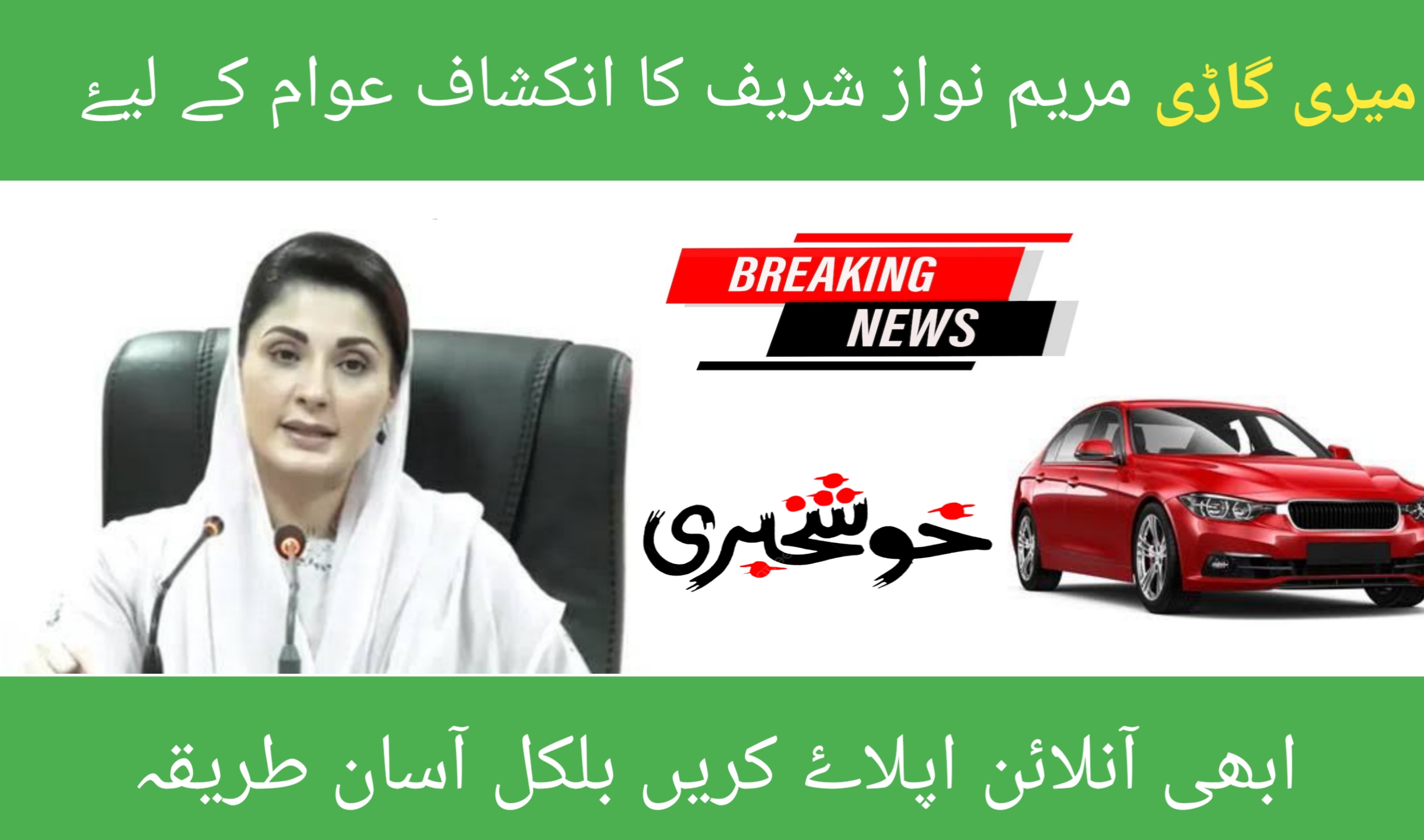
In a province where the rhythm of life is set by the hum of engines and the constant flow of people, mobility is not a luxury—it is the very lifeline of economic survival and social progression. Recognizing this fundamental truth, Punjab’s first female Chief Minister, Maryam Nawaz Sharif, has launched the ambitious “Meri Gari” (My Car) Scheme, a flagship initiative aimed at democratizing vehicle ownership for the province’s working and middle classes. More than just a subsidy program, “Meri Gari” represents a bold foray into digital governance, leveraging technology to promise transparency, accessibility, and a tangible step towards financial inclusion. At its heart lies a revolutionary feature: the Online Apply portal, designed to dismantle bureaucratic barriers and place opportunity at the fingertips of millions.
Vision and Rationale: Wheels for the Working Class
The scheme emerges against a backdrop of soaring inflation and stagnant wages, where the dream of owning a personal vehicle—a catalyst for better employment, enhanced business opportunities, and improved family mobility—has receded for many. Traditional auto finance, with its high markups and stringent requirements, often remains out of reach for salaried individuals, low-income professionals, and small business owners.
Chief Minister Maryam Nawaz’s vision for “Meri Gari” is explicitly populist and economically astute. The scheme aims to:
-
Stimulate Economic Activity: By increasing vehicle ownership, the initiative is expected to boost the local automotive industry, create jobs in manufacturing and ancillary services, and increase the efficiency of the workforce.
-
Promote Financial Inclusion: It brings formal financing to segments of the population that may have previously interacted only with informal lending systems.
-
Enhance Social Mobility: A reliable vehicle can reduce hours lost in commute, expand job search radii, enable safer travel for families, and fundamentally improve quality of life.
-
Set a Digital Precedent: The online-centric model signals a commitment to a paperless, efficient, and user-friendly government service delivery system.
The Digital Cornerstone: The “Online Apply” Portal
The most transformative aspect of the “Meri Gari” Scheme is its application process. Moving away from the notorious “gherao” of offices and intermediaries, the government has launched a dedicated online portal. This digital gateway is intended to be the great equalizer.
The Promised Process:
-
Eligibility Check: Prospective applicants are expected to visit the official scheme website. Here, they will likely find clear eligibility criteria, such as being a Punjabi domicile holder, having a minimum monthly income, falling within a certain age bracket, and possessing a valid driver’s license.
-
Document Upload: The portal would guide users to digitally upload scanned copies of necessary documents: CNIC, proof of income (salary slips or business documents), domicile certificate, and utility bills for address verification.
-
Vehicle Selection & Bank Partnering: The scheme is expected to collaborate with specific automobile manufacturers and assembled-in-Pakistan models to keep costs manageable. Applicants may choose from a pre-selected list of vehicles. The scheme is also tied to participating banks and financial institutions that will handle the actual financing, with the government subsidizing the markup or providing a guarantee.
-
Transparent Tracking: A major selling point is the promise of an application tracking system. Applicants can theoretically log in to see the real-time status of their submission—under review, approved, sent to bank, etc.—reducing anxiety and the potential for corruption.
-
Direct Communication: Notifications regarding approval, required next steps, or discrepancies would be sent via SMS or email, ensuring a direct line between the citizen and the scheme administrators.
Advantages of the Online Model:
-
Accessibility: Anyone with an internet connection—from a smartphone in a village to a computer in an office—can apply, 24/7.
-
Transparency: Automated systems reduce human discretion at the initial filter, minimizing opportunities for graft and favoritism.
-
Efficiency: Digital processing can significantly cut down approval times compared to manual file handling.
-
Scalability: The system can handle a large volume of applications simultaneously, which is crucial for a demand-heavy program in a province of over 120 million people.
Potential Challenges and Critical Considerations
However, the road to digital utopia is often bumpy. The success of the “Meri Gari” Scheme hinges on overcoming significant hurdles:
-
The Digital Divide: While smartphone penetration is high, digital literacy is not uniform. Many potential beneficiaries in rural or peri-urban areas may struggle with the online process, necessitating a parallel support system of help desks or kiosks.
-
Infrastructure and Glitches: Government portals in Pakistan have a history of crashing under peak load. The scheme’s website must be robust, secure, and capable of handling millions of hits without failing—a considerable technical challenge.
-
Verification & Fraud Prevention: The integrity of the scheme depends on foolproof verification of uploaded documents. This requires seamless integration with databases of NADRA, the Federal Board of Revenue (FBR), and employers—a complex inter-departmental task.
-
The Fine Print: The devil lies in the details of financing. What will be the effective interest rate after subsidy? What is the down payment requirement? Are there hidden charges? The terms must be exceptionally clear and genuinely affordable to avoid trapping beneficiaries in debt.
-
Sustainability and Scale: The most pressing question is of resources. How many vehicles can the provincial government realistically subsidize? Will the selection be a transparent lottery, first-come-first-served, or based on a poverty scorecard? A poorly managed selection process could lead to public disillusionment.
-
Economic Impact: Critics may argue that the subsidy could distort the auto market or that the funds might be better spent on mass transit. Proponents, however, see it as a direct investment in individual productivity.
A Comparative and Political Lens
“Meri Gari” is not conceived in a vacuum. It follows in the footsteps of federal-level schemes like the earlier “Apna Chatha, Apna Ghar” and various laptop distribution initiatives. It fits squarely within the political narrative of the Pakistan Muslim League-Nawaz (PML-N) of delivering tangible, life-improving goods to its constituency. For CM Maryam Nawaz, it carries added significance as a signature policy that establishes her administrative credentials and direct connection with the public, particularly the youth and the aspiring lower-middle class.
The scheme’s success or failure will be a major marker for her government. If implemented smoothly, it could redefine public expectations for service delivery in Punjab. If plagued by delays, technical issues, or perceptions of unfairness, it could become a symbol of unfulfilled promises.
Conclusion: More Than Just a Car
The “Meri Gari” Scheme is a fascinating case study in 21st-century governance. It intertwines a classic welfare objective—asset transfer—with a modern, tech-enabled methodology. It is a test of Punjab’s bureaucratic capacity to innovate and of its citizens’ readiness to engage with the state digitally.
Ultimately, the scheme’s true value may be measured beyond the number of cars disbursed. It represents a promise: that the government can be accessible through a screen, that procedures can be straightforward, and that the benefits of development can be directed fairly to those who need them most. For the daily wage worker dreaming of a rickshaw to expand his clientele, the schoolteacher hoping for a small car for her family’s safety, or the young graduate needing transport for his first job, “Meri Gari” is not just about metal and machinery. It is about dignity, opportunity, and the empowering feeling of claiming one’s rightful place on the road—and in the economy—of Punjab.
The “Online Apply” button is, therefore, more than a digital interface; it is a gateway to that promise. As thousands click it in hope, the Government of Punjab shoulders the heavy responsibility of ensuring that this digital highway leads not to a dead end of frustration, but to a destination of realized dreams and accelerated prosperity.