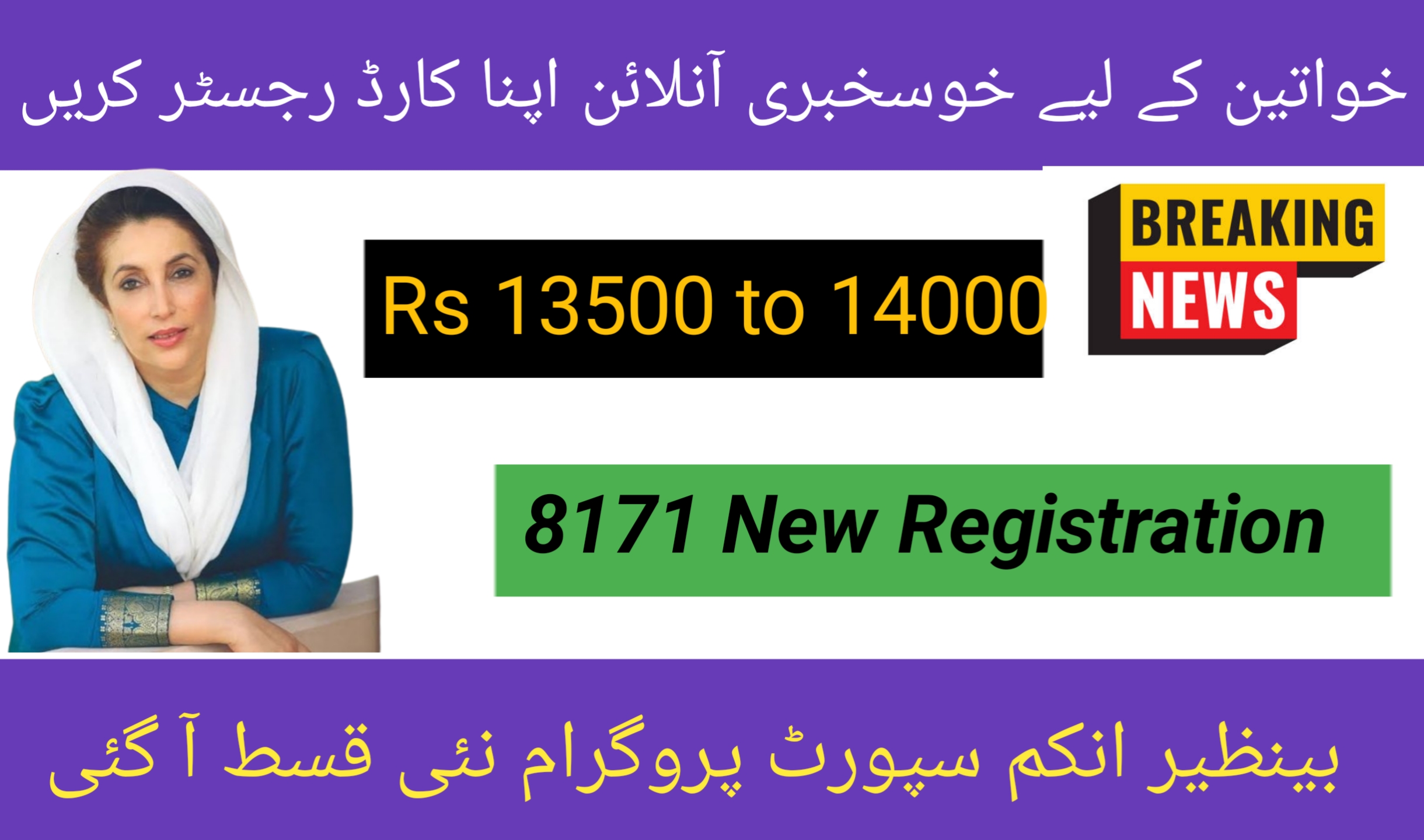
In a move poised to significantly impact the lives of millions of its most vulnerable citizens, the Benazir Income Support Programme (BISP) has announced a substantial increase in its quarterly disbursements, setting a new benchmark of Rs. 13,500 per tranche for the year 2026. This decision, far more than a routine inflationary adjustment, represents a profound policy shift—a powerful affirmation of the state’s commitment to social protection as a cornerstone of economic stability and human dignity. The announcement has ignited a national conversation on poverty alleviation, fiscal responsibility, and the evolving role of cash transfers in a developing economy.
Context: The BISP Journey from Safety Net to Springboard
To fully grasp the magnitude of this announcement, one must understand BISP’s trajectory. Established in 2008 amidst global economic turmoil and domestic instability, its initial purpose was to provide a simple, unconditional cash buffer to protect women-led, ultra-poor households from absolute destitution. For years, the stipend, often hovering between Rs. 4,500 to Rs. 9,000 quarterly, was a lifeline, yet one that barely kept pace with the brutal realities of inflation, particularly for essentials like food, energy, and healthcare.
The incremental increases over time were often seen as catch-up measures. However, the leap to Rs. 13,500 signals a transformative intent. It moves the stipend from being a mere subsistence allowance towards a more meaningful economic resource—a sum that can not only prevent hunger but also enable a degree of financial planning, minor investment in children’s education or health, and a buffer against small shocks. This aligns with global evidence that demonstrates how higher-value, predictable cash transfers can act as a springboard out of intergenerational poverty, rather than just a net to catch those falling through the cracks.
The Rationale: Economics, Empathy, and Empowerment
Several converging factors underpin this landmark decision:
-
Runaway Inflation and the Cost-of-Living Crisis: Pakistan has weathered severe economic storms in recent years, with double-digit inflation eroding the purchasing power of the poor at an alarming rate. The previous stipend amounts were being drastically hollowed out. The Rs. 13,500 figure, a 50% increase from some earlier tranches, is a direct and necessary response to restore and enhance the real value of the support. It acknowledges that the “minimum threshold of dignity” has a higher economic cost today.
-
A Commitment to Human Capital Development: There is growing recognition that poverty is multidimensional. It’s not just a lack of income but a deprivation of opportunities in health, education, and nutrition. A significantly larger cash transfer, placed directly in the hands of women (who are the primary recipients under BISP), has a well-documented ripple effect. Studies on BISP and similar programs worldwide show increased school enrollment, improved prenatal and postnatal care, and better dietary diversity within beneficiary households. By empowering women economically, the state is investing in the health and education of the next generation, breaking the cycle of poverty at its root.
-
Strengthening Social Contract and Political Stability: In times of economic distress, visible and tangible support to the most marginalized segments of society is crucial for maintaining social cohesion. This increase sends a powerful message of solidarity. It reinforces the state’s presence in the lives of the poor, potentially strengthening the social contract and fostering greater political stability—an essential precondition for long-term economic growth.
-
Technological and Administrative Maturity: The ability to announce and implement such an increase for 2026 also reflects confidence in BISP’s evolved infrastructure. The shift to biometric verification, dedicated bank accounts/payment cards, and a more dynamic National Socio-Economic Registry (NSER) has reduced leakages, minimized corruption, and improved targeting efficiency. This operational robustness provides the fiscal and logistical confidence to scale up payment values significantly.
Implications and Expected Impact
The announcement of the Rs. 13,500 payment carries profound implications across multiple domains:
-
For Beneficiary Households: This translates to a tangible improvement in quality of life. It means the ability to afford more nutritious food, pay for a child’s school supplies without sacrificing a meal, cover a portion of utility bills, or save a small amount for emergencies. For the female recipients, it enhances their decision-making authority and status within the household and community.
-
For Local Economies: Contrary to the misconception that cash transfers are inflationary or foster dependency, evidence suggests they stimulate local, often informal, economies. This money is spent immediately on basic goods and services—groceries, clothing, local transport, small vendors—thereby injecting liquidity and creating demand at the grassroots level. The multiplier effect of this cash infusion into low-income communities can be significant.
-
For the National Poverty Landscape: While not a silver bullet, this enhanced stipend is a powerful tool. It will directly reduce the poverty gap (the intensity of poverty) and, if sustained, can contribute to lowering the poverty headcount. It acts as a stabilizer, preventing families from resorting to catastrophic coping strategies like pulling children out of school, selling productive assets, or taking on debilitating debt.
Challenges and Considerations
Despite the unequivocal benefits, this policy shift does not occur in a vacuum and presents several challenges:
-
Fiscal Sustainability: The single most pressing question is cost. With an estimated 9.3 million beneficiary families, a Rs. 13,500 quarterly payment represents a massive annual commitment from the federal budget. In an era of tight fiscal space, high debt servicing, and competing demands from infrastructure and defense, securing this allocation consistently will require strong political will and may necessitate difficult trade-offs or increased revenue mobilization.
-
Inflationary Pressures: While local demand stimulation is positive, a large-scale, nationwide injection of cash could contribute to demand-pull inflation, especially in sectors supplying basic commodities, if not matched by an increase in supply. Careful macroeconomic coordination is essential.
-
Targeting and Exclusion Errors: While the NSER has improved, no system is perfect. The perennial challenge remains ensuring that all eligible families are included (minimizing exclusion errors) and ineligible ones are kept out (minimizing inclusion errors). Continuous updating and validation of the registry are critical to maintain the program’s legitimacy and effectiveness.
-
Beyond Cash: The Need for Complementary Services: Cash is necessary but not sufficient. Its impact is maximized when paired with access to quality services. A mother may have money for medicine, but needs a functional Basic Health Unit nearby. She may pay school fees, but requires a school with teachers in attendance. Therefore, BISP’s success is inextricably linked to parallel investments in public service delivery across Pakistan.
The Road to 2026: A Call for Strategic Integration
The announcement sets a bold direction. The journey to 2026 must now focus on strategic integration:
-
Formalizing the Increase: This pledge must be cemented in the upcoming federal budgets, with transparent allocation and robust parliamentary oversight to ensure it is insulated from political or fiscal volatility.
-
Linking to Broader Development Goals: BISP should be more deeply integrated with initiatives in health (e.g., conditional transfers for vaccination), education (stipend top-ups for secondary school attendance), and financial inclusion (promoting savings accounts and digital literacy).
-
Ensuring Transparency and Grievance Redressal: Strengthening mechanisms for beneficiaries to verify payments, report issues, and seek corrections is vital for trust and accountability.
Conclusion: More Than Money, A Measure of Priorities
The announcement of a Rs. 13,500 BISP payment for 2026 is a watershed moment for social protection in Pakistan. It transcends arithmetic and enters the realm of national values. It is a statement that in the calculus of development, the welfare of the most impoverished is not a residual afterthought but a central priority.
This increase is a powerful investment—in social justice, in economic resilience, and in the untapped potential of millions of Pakistanis. If implemented with fiscal prudence, administrative integrity, and coupled with improvements in service delivery, it has the potential to redefine the lives of a generation, making the social safety net not just a provider of survival, but a catalyst for dignity, opportunity, and hope. The path to 2026 will test Pakistan’s commitment, but the direction set is unequivocally the right one.