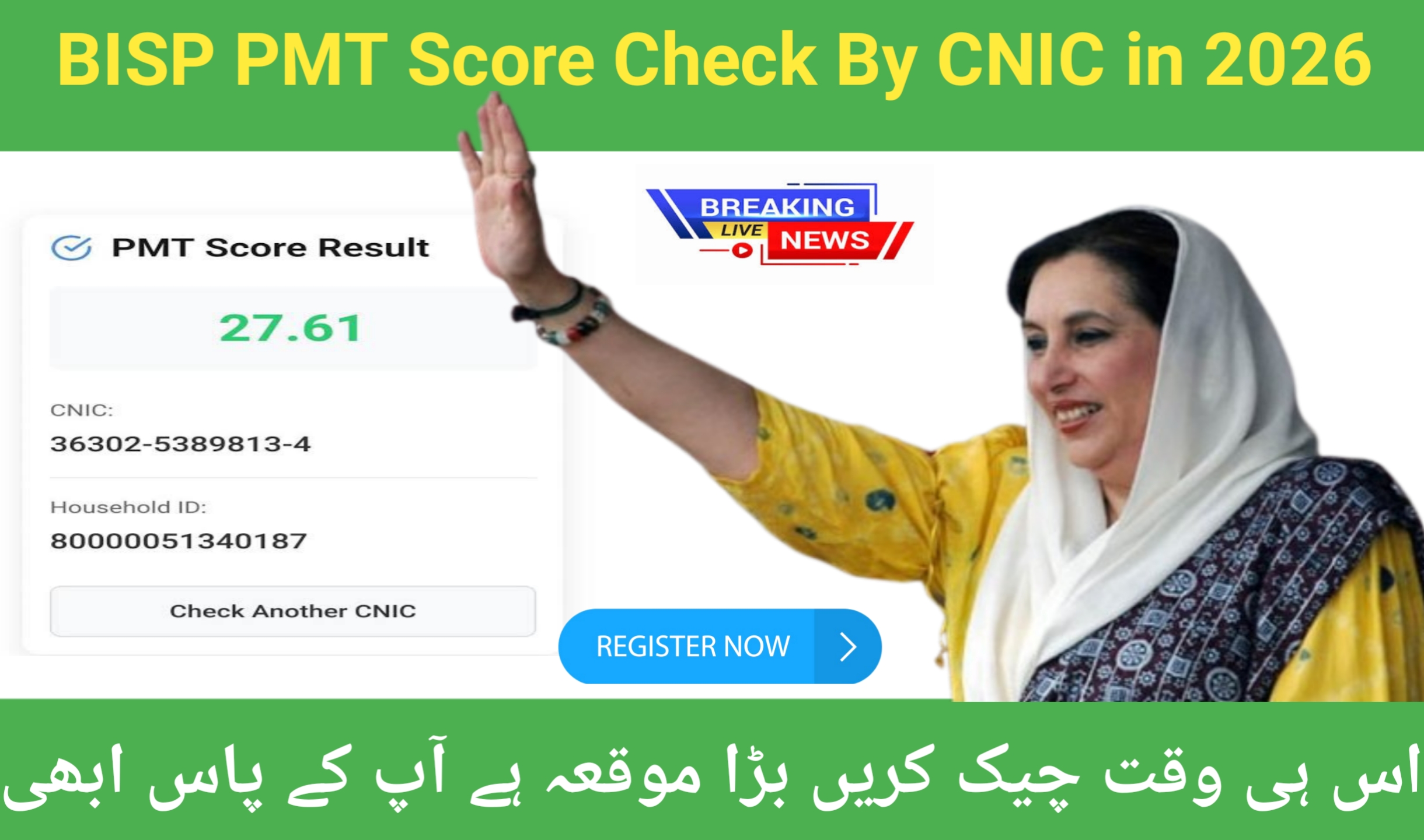
The PMT Score: The Digital Gatekeeper of Eligibility
The PMT is not a simple income check. It is a multivariate algorithm that uses verifiable, observable household characteristics—such as asset ownership, housing conditions, education levels, and utility connections—to predict a family’s consumption and economic well-being. The result is a numeric PMT Score. Households scoring below a certain government-defined poverty threshold are deemed eligible for the BISP Kafaalat cash transfer.
In 2026, this model has likely undergone refinements. With richer data sets from successive surveys (like the National Socio-Economic Registry or NSER updates) and advancements in data analytics, the PMT in 2026 is presumed to be more accurate, aiming to better distinguish between the truly destitute and the marginally better-off, reducing inclusion and exclusion errors.
The 2026 Process: How to Check Your PMT Score by CNIC
Gone are the days of relying solely on sporadic SMS replies or visiting BISP offices for every query. The system in 2026 is characterized by multi-channel access, though the core identifier remains the Computerized National Identity Card (CNIC) number.
-
Official BISP 8171 Web Portal: The primary and most detailed method. Beneficiaries and applicants can visit the official BISP or 8171 portal, navigate to the eligibility or PMT score check section, enter their CNIC number, and view not just their eligibility status but potentially a broader breakdown of their standing. The portal may also show payment histories, upcoming payment dates, and allow for the submission of grievances.
-
Dedicated Mobile Application: A official BISP app, available on Android and iOS platforms, likely offers a more streamlined experience. With a CNIC login, users can check their PMT score/eligibility, receive notifications, and access program updates securely on their smartphones.
-
SMS Service (8171): The ubiquitous and most accessible service, especially in rural areas with low internet penetration. Sending your 13-digit CNIC number (without dashes) to 8171 returns an automated SMS reply. However, in 2026, this message might provide more than a simple “Eligible/Not Eligible.” It could include the PMT score band (e.g., “Your household PMT Score is 18.7”) or a specific reason code for ineligibility, directing applicants to the next steps.
-
Beneficiary Service Centers: Physical centers across districts remain vital for those facing digital barriers. Here, staff can perform the CNIC-based check on the internal system, provide printed results, and offer immediate guidance for appeals or registration.
-
Integrated Government Portals: In line with the vision of a digital governance ecosystem, the PMT score check may also be accessible through integrated platforms like the Pakistani Government’s Citizen Portal, where a CNIC can fetch information from multiple social programs, including BISP.
The “Score” in 2026: Beyond a Binary Yes/No
A significant shift in 2026 is the move towards greater transparency. While the exact weighting of the PMT formula remains confidential (to prevent manipulation), the system is now better at communicating why a decision was made. An applicant declared ineligible might receive a notification hinting at the primary factor—for instance, “Ineligibility due to asset profile” or “Score above threshold based on household composition and utilities.”
Furthermore, the PMT score is no longer static. The Dynamic Registry is a reality in 2026. Households can request a re-survey if their circumstances drastically worsen (e.g., due to a flood, illness, or death of a breadwinner). Conversely, families that have sustainably improved their status over years of support may be graduated out, making room for others. This dynamic nature makes periodic checks via CNIC crucial for existing and potential beneficiaries.
Persistent Challenges and Considerations
Despite technological advances, the human and systemic challenges persist:
-
The “Exclusion Error” Dilemma: The greatest criticism of the PMT remains that it can exclude genuinely poor families whose poverty is not perfectly captured by the proxy indicators. A family may own a small, inherited piece of land (an asset) but have zero productive income, yet score above the threshold.
-
Data Lag and Real-Time Reality: The NSER data, while updated more frequently than in the past, still represents a snapshot in time. A sudden economic shock may not be reflected until the next survey cycle, leaving families in desperate need without support.
-
Digital Literacy and Access: For elderly or illiterate women, who form the majority of beneficiaries, navigating web portals or even SMS menus can be daunting. The role of family support or helper agents at service centers remains critical.
-
Appeals and Grievance Redressal: The mechanism for contesting a PMT score—the Complaint Redressal System—must be robust, fair, and swift. In 2026, the expectation is for a trackable online complaint ID that allows applicants to follow their appeal’s progress after a re-assessment.
The Broader Ecosystem: PMT as a Tool for Holistic Support
In 2026, BISP’s PMT score is increasingly serving as a gateway to a wider social protection ecosystem. A low PMT score doesn’t just unlock the Kafaalat cash transfer; it can seamlessly qualify household members for:
-
BISP Education Stipends (Waseela-e-Taleem): Encouraging school enrollment for children.
-
Health Insurance Programs: Like the Sehat Sahulat Program, providing access to healthcare.
-
Climate Resilience and Livelihood Grants: Targeted support for families in climate-vulnerable districts.
This integrated approach moves BISP from being a cash transfer program to being the backbone of a multi-dimensional poverty alleviation strategy.
Conclusion: A More Mature, Yet Imperfect, Lifeline
Checking your BISP PMT score by CNIC in 2026 is a journey into the heart of Pakistan’s effort to build a data-driven, equitable social safety net. The process is undeniably smoother, more accessible, and informative than ever before. The evolution towards dynamic registration and integrated benefits is a positive step forward.
However, the core tension remains: balancing algorithmic efficiency with human nuance. The PMT score is a powerful tool, but it must be administered with a layer of empathy and a strong, accessible mechanism for correction. For the millions who depend on it, the number tied to their CNIC is more than a data point; it is a determinant of their household’s stability. As BISP moves forward, the continuous refinement of the PMT, coupled with a relentless focus on reducing exclusion errors, will determine whether this digital gatekeeper truly serves as a fair and compassionate guardian of Pakistan’s most vulnerable citizens.