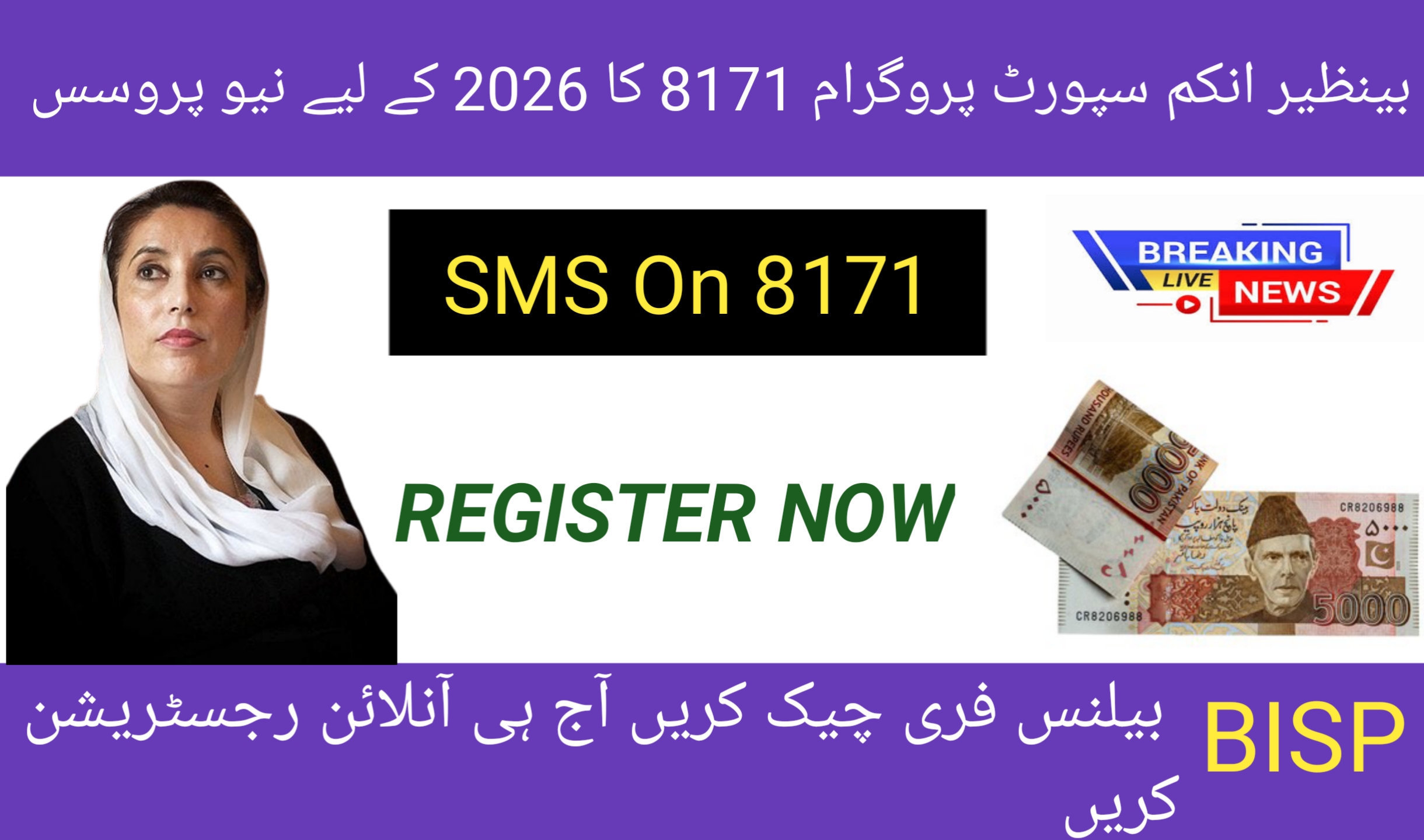
In the landscape of Pakistan’s social welfare initiatives, the Benazir Income Support Programme (BISP) stands as a monumental endeavor. Since its inception in 2008, it has served as a critical lifeline for millions of families trapped in the cyclical grip of poverty. As the program evolves to meet contemporary challenges, the announcement of the BISP 8171 New Registration Process for the 2025-2026 cycle marks a significant update. This process is not merely an administrative procedure; it is a gateway to dignity, financial security, and empowerment for the nation’s most vulnerable citizens. This article provides a detailed overview of the new registration process, its objectives, technological enhancements, and the profound impact it aims to achieve.
Understanding BISP and the 8171 Portal
BISP is the federal government’s flagship social safety net program, providing unconditional cash transfers to qualifying low-income families, predominantly women-led households. The program’s core objectives are poverty alleviation, women’s economic empowerment, and human capital development through initiatives like conditional cash transfers for education and health.
The 8171 number has become synonymous with BISP. It is the official SMS shortcode and the name of the digital portal that serves as the primary interface between the program and its beneficiaries. This system is designed to bring transparency, efficiency, and accessibility to the massive task of registering and verifying millions of potential beneficiaries across Pakistan’s diverse and often remote terrain.
The Rationale for the New 2025-2026 Registration Cycle
Each new registration cycle allows BISP to:
-
Update the National Socio-Economic Registry (NSER): Poverty dynamics are fluid. Families move in and out of poverty due to economic shocks, health crises, or climate events. The new cycle aims to refresh the data, ensuring assistance reaches those who need it most now.
-
Incorporate New Eligible Families: Many families who were previously ineligible or who missed past surveys may now qualify due to changed circumstances.
-
Leverage Advanced Technology: With each cycle, BISP integrates more sophisticated tools to improve accuracy, reduce fraud, and streamline operations.
-
Align with Broader Policy Goals: The process is tailored to support the government’s wider economic and social inclusion agendas for the fiscal years 2025-2026.
Step-by-Step: The New Registration Process for 2025-2026
The new process is expected to be a blend of door-to-door surveys, designated registration centers, and digital self-service options. Here is a step-by-step breakdown based on trends and official announcements.
1. Awareness and Announcement Phase:
The process begins with a nationwide public awareness campaign. The government will use television, radio, newspapers, and social media to announce the start of the new registration cycle, detailing timelines, required documents, and methods.
2. Eligibility Criteria:
While the official criteria for 2025-2026 will be published by BISP, they are typically based on a Proxy Means Test (PMT) that scores households using indicators like:
-
Household composition and size.
-
Employment status and income sources.
-
Asset ownership (e.g., land, livestock, vehicles).
-
Housing conditions (e.g., construction material, utilities).
-
Women-led households, widows, and persons with disabilities are often given priority.
3. Methods of Registration:
A) Door-to-Door Survey by BISP Teams:
This is the most common and inclusive method. BISP enumerators, equipped with biometric devices and tablets, visit villages and urban neighborhoods. They collect data directly from households, capturing biometric fingerprints (thumb impressions) and photographs alongside the socio-economic survey. This method is crucial for reaching populations with low digital literacy or limited mobility.
B) Registration at Designated BISP Tehsil Offices:
Eligible families can visit their nearest BISP tehsil or district office to register in person. They must bring their required documents for data entry and biometric verification.
C) Online Self-Registration via the 8171 Web Portal:
For the tech-savvy, BISP is expected to further enhance its online portal. Potential beneficiaries may be able to initiate registration by filling a preliminary form on the official 8171 website, though this will likely need to be followed by an in-person biometric verification.
D) SMS Service (The Classic 8171 Method):
Individuals can check their eligibility or registration status by sending their 13-digit Computerized National Identity Card (CNIC) number to 8171. For the new cycle, this service will be updated to inform people if a survey team is scheduled in their area or if they need to visit a center.
4. Required Documents:
Applicants must have:
-
Original CNIC of the female head of the household.
-
CNICs of all adult family members.
-
Children’s Birth Registration Forms (B-Forms).
-
Proof of income (if any), such as a salary slip or employer certificate.
-
Utility bills (gas, electricity) as proof of residence.
-
Disability certificate, if applicable.
5. Data Verification and Eligibility Determination:
Once collected, the data is encrypted and transmitted to the central NSER database. The PMT algorithm analyzes the information and assigns a poverty score. Households scoring below the government-defined threshold are deemed eligible.
6. Notification and Inclusion:
Eligible families are notified via an SMS on the provided mobile number. The message confirms their registration and provides a unique identification code. Once enrolled, they become eligible for the quarterly Kafaalat cash transfer, which is disbursed through partner bank branches or authorized biometric ATMs/agents.
Technological Innovations in the 2025-2026 Process
The new cycle is anticipated to feature several tech-driven improvements:
-
Enhanced Biometric Integration: More secure and faster biometric devices to prevent duplicate registrations and identity fraud.
-
Real-Time Data Syncing: Surveyor tablets syncing directly with the central server to minimize data errors and delays.
-
Geo-Tagging of Households: To ensure physical verification and accurate mapping of beneficiary locations.
-
Blockchain for Transparency (Pilot Potential): There have been discussions about using blockchain technology to create an immutable record of transactions, further enhancing trust in the system.
-
AI-Powered Data Analytics: To better identify poverty patterns and improve the targeting accuracy of the PMT.
Challenges and the Path Forward
Despite its improvements, the registration process faces persistent challenges:
-
Logistical Hurdles: Reaching remote areas of Balochistan, Sindh, and mountainous regions remains difficult and expensive.
-
Sociocultural Barriers: In some conservative areas, male family members may restrict women’s interaction with survey teams or their access to CNICs.
-
Digital Divide: Reliance on online portals can exclude those without internet access or digital skills.
-
Disinformation: Rumors and misinformation about the program’s intentions can create distrust.
-
Capacity and Corruption: Ensuring a vast network of enumerators and officials adheres to strict ethical standards is an ongoing task.
To address these, BISP must continue its community engagement programs, work closely with local leaders, strengthen monitoring and grievance redressal systems (like the 8171 helpline), and invest in continuous staff training.
The Broader Impact: Beyond Cash Transfers
The significance of the BISP 8171 registration transcends the disbursement of cash. It is a foundational step for:
-
Women’s Agency: By transferring money directly to women’s biometric-enabled bank accounts, BISP enhances their financial decision-making power and status within households.
-
Financial Inclusion: The program brings millions of unbanked women into the formal financial system.
-
Human Development: Linkages to health and education initiatives encourage school enrollment and maternal healthcare.
-
Economic Resilience: The predictable cash flow helps families manage shocks, avoid catastrophic debt, and invest in small-scale productive activities.
Conclusion: A Beacon of Inclusive Growth
The BISP 8171 New Registration Process for 2025-2026 represents more than a bureaucratic exercise; it is a reaffirmation of the state’s commitment to its most marginalized citizens. By refining its methods and harnessing technology, BISP aims to construct a more accurate, dynamic, and responsive social registry.
For eligible families, navigating this process is the first step toward stability in an uncertain economic climate. For Pakistan, it is an investment in social cohesion and equitable development. As the new cycle rolls out, its success will hinge on effective communication, empathetic execution, and relentless transparency. In the simple act of sending an SMS to 8171 or opening their door to a surveyor, millions of Pakistanis are not just registering for a program—they are securing their stake in a more hopeful and inclusive future. The journey out of poverty is long and complex, but with an effective and fair registration process, BISP ensures that no one has to walk that path alone.