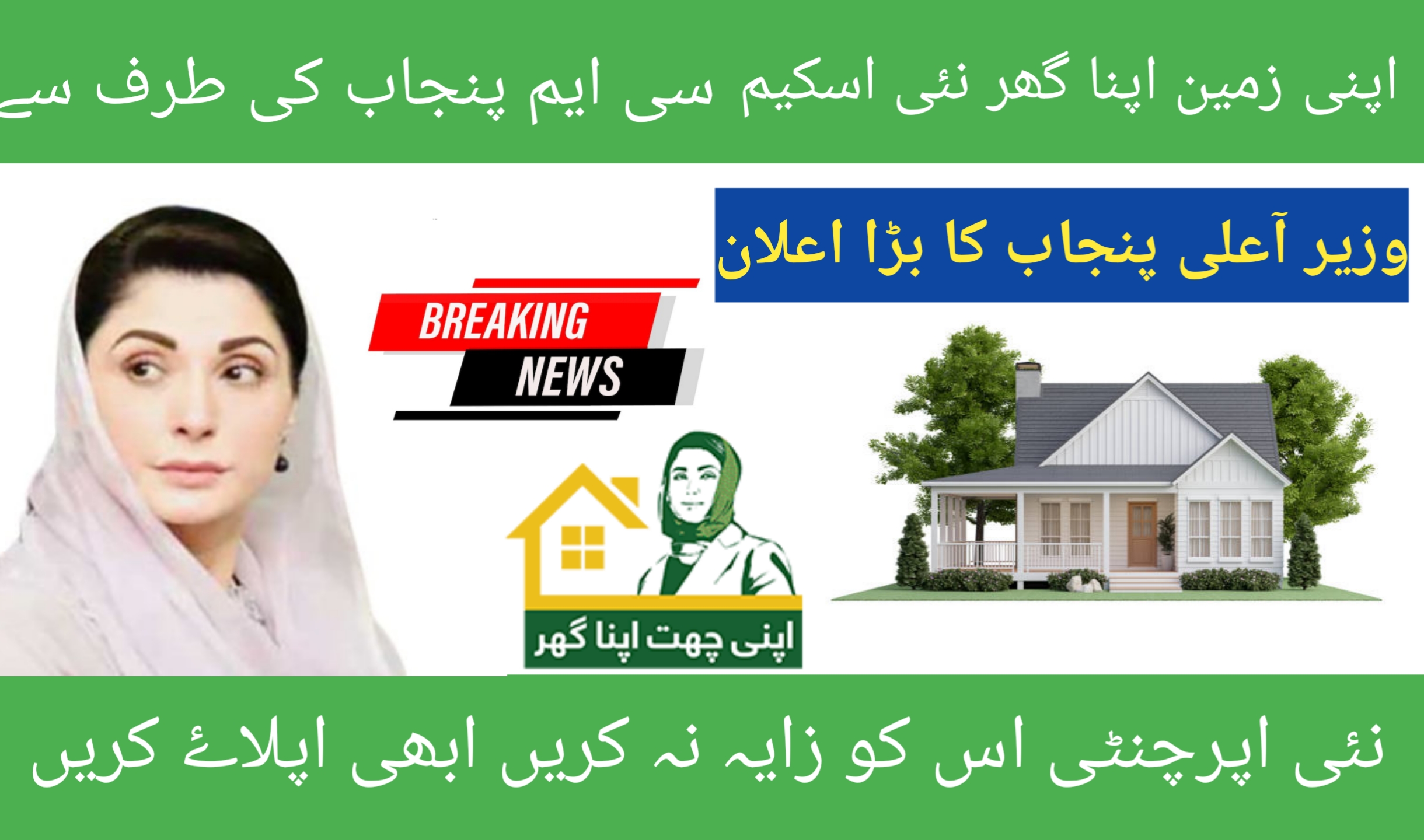
In the tumultuous landscape of Pakistani politics, where promises often dissolve into the ether of economic realities, the announcement of a new housing scheme invariably captures public imagination. “Apni Zameen Apna Ghar” (Your Own Land, Your Own Home), unveiled under the banner of Punjab Chief Minister Maryam Nawaz Sharif in early 2026, is the latest entrant in this fraught arena. Positioned as a cornerstone of her social welfare agenda, the scheme promises to democratize home ownership for low and middle-income families. Yet, in a nation weary of grand announcements and familiar with the chasm between political pledges and tangible outcomes, the initiative demands scrutiny beyond its populist veneer.
The Blueprint: Core Components of the Scheme
At its heart, “Apni Zameen Apna Ghar” is presented as a comprehensive public-private partnership aimed at addressing Punjab’s acute housing shortage, estimated to be in the millions. The scheme’s architecture, as outlined in preliminary government documents and speeches, rests on several key pillars:
-
Affordable Land Parcels: The government plans to identify and develop state-owned land on the peripheries of major urban centers like Lahore, Faisalabad, Multan, and Rawalpindi. These parcels will be offered to eligible citizens at subsidized rates, significantly below market value, through a transparent balloting system.
-
Subsidized Financing: In collaboration with designated banks and the State Bank of Pakistan, the scheme proposes low-markup, long-term mortgage facilities. Special windows are promised for blue-collar workers, government employees, and young professionals, with down payments claimed to be as low as 10%.
-
Integrated Township Development: Unlike isolated plot schemes, the plan envisages developed townships with essential infrastructure—roads, water supply, sewage, and electricity—pre-installed. Promises of dedicated spaces for schools, basic healthcare centers, and commercial markets aim to prevent the creation of barren suburban ghettos.
-
Transparent Digital Portal: A major selling point is the pledge of a fully digitized application, balloting, and allotment process to minimize human intervention and curb the corruption that has plagued past schemes.
The target demographic is broad: from registered labourers and low-tier government servants to the urban salaried class crushed by runaway rental and real estate markets. The narrative is powerful: empowering the common citizen with the ultimate asset—land—and the dignity of a self-owned home.
The Historical Context: A Legacy of Unfulfilled Promises
To understand the skepticism that greets “Apni Zameen Apna Ghar,” one must glance backward. Housing schemes have long been a political staple in Pakistan. From Pervez Musharraf’s “Ashiana Housing” to the PMLN’s own previous “Naya Pakistan Housing Programme” under Shehbaz Sharif, and PTI’s ambitious but struggling “Naya Pakistan Housing and Development Authority,” the history is checkered.
These initiatives consistently stumbled over the same hurdles: bureaucratic inertia, litigation over land ownership, chronic underfunding, and the sheer scale of demand overwhelming the supply mechanism. Allotments were often mired in allegations of preference, with “files” of deserving applicants languishing for years. Many announced projects either remained on paper or transformed into commercial ventures for the well-connected. The public’s memory of these failures casts a long shadow over Maryam Nawaz’s new pledge.
Furthermore, the scheme’s branding is intensely political. Launched in an election cycle hangover, it is seen as a tool to consolidate the PMLN’s base, particularly among the urban poor and aspirational middle class in Punjab, the party’s fortress. The name itself evokes a sense of nationalist and personal ownership, a direct emotional appeal. Critics argue it is less a revolutionary policy and more a repackaging of an old political playbook, where housing schemes serve as instruments of patronage rather than sustainable urban policy.
The Mountainous Challenges: From Vision to Reality
The pathway from announcement to implementation is mined with formidable challenges:
-
The Land Quagmire: The most significant obstacle. Identifying uncontested, litigation-free state land in viable locations near cities is a herculean task. Most such land is already encroached, disputed, or controlled by various powerful state and military entities. Acquiring and consolidating it will trigger a thousand bureaucratic and political battles.
-
Financial Sustainability: The economics are precarious. Offering deep subsidies on land and credit in an economy grappling with high inflation, a shaky rupee, and IMF-mandated fiscal discipline raises questions. Who bears the true cost? Will it further strain public finances, or will the private sector’s participation be meaningful and not merely exploitative?
-
Execution Capacity: The track record of Punjab’s development authorities in delivering large-scale, transparent housing projects is poor. Issues of quality construction, timely provision of utilities, and adherence to master plans have persistently arisen. The proposed digital system, while laudable, must contend with low digital literacy and attempts to game the system.
-
Urban Planning Paradox: By promoting expansion on city outskirts, the scheme risks exacerbating urban sprawl, increasing commute times, and straining already fragile civic services in core cities. Without simultaneous massive investment in public transport and job creation in these new townships, they could become dormitory settlements, adding to social and economic stress.
-
The Speculation Specter: A chronic issue in Pakistani housing schemes is the immediate resale of allotted plots by original allottees to speculators, defeating the purpose of providing homes. Preventing this requires stringent legal covenants, which are often laxly enforced.
A Comparative Lens: Learning from Global Models
For “Apni Zameen Apna Ghar” to avoid past pitfalls, it could look beyond borders. Singapore’s Housing Development Board (HDB) model, while unique, offers lessons in rigorous long-term planning, high-quality construction, and a strict regulatory framework that prioritizes owner-occupation over investment. Closer home, India’s Pradhan Mantri Awas Yojana (PMAY), despite its own challenges, has attempted a multi-pronged approach involving credit-linked subsidies, slum redevelopment, and direct beneficiary-led construction.
The critical lesson is that successful affordable housing is not a real estate handout but an integrated habitat development program. It must be dovetailed with employment, transportation, education, and healthcare policies. It requires a depoliticized, technocratic authority with continuity across political administrations—a rare commodity in Pakistan’s volatile polity.
Conclusion: A Cautious Hope Amidst Familiar Doubts
“Apni Zameen Apna Ghar” enters a field where hope and cynicism are perennial competitors. There is no denying the acute, genuine need it seeks to address. For millions of Pakistanis living in precarity, the dream of land and a home is a powerful motivator. If even partially and honestly implemented, the scheme could provide tangible relief and stimulate the construction sector.
However, the weight of history and the enormity of the challenges counsel extreme caution. The scheme’s ultimate test will not be in its eloquent launches or well-designed portals, but in the silent, slow grind of execution: in the transfer of clear titles to the first thousand allottees, in the timely laying of sewer lines in new sectors, and in the accessibility of its loans to a factory worker without political references.
Maryam Nawaz, by staking political capital on this project, has framed it as a legacy-defining endeavor. It presents an opportunity to break from a past of patronage-based development. Yet, in the intricate dance of Pakistani politics, where populist announcements often precede patronage-driven distribution, “Apni Zameen Apna Ghar” remains suspended between a transformative vision and a familiar political pageant. The people of Punjab, and indeed all observers, will be watching not the headlines of 2026, but the ground reality of 2027 and beyond, to deliver their final verdict. The gap between zameen (land) on paper and ghar (home) in reality is where Pakistan’s development dreams have historically been lost. Bridging it would be a true revolution.